
After Youth Soccer: Where NCAA, UPSL, USL League Two and WPSL Fit
Most players who keep going after U19 play college or adult amateur soccer. Here is how the NCAA, the UPSL, USL League Two, the USL W League, the WPSL and city leagues fit together.
By MyLeagueRankings ·
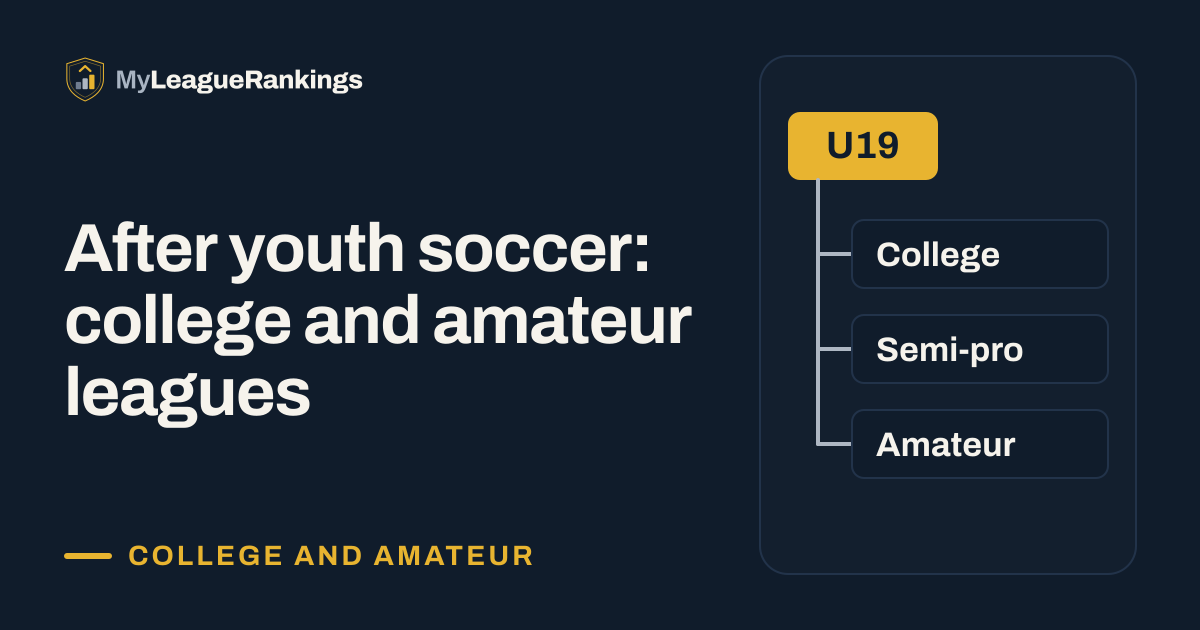
Youth soccer ends at U19, and for most players who keep playing, the next step is not a professional contract. It is college soccer, an adult amateur or semi-pro league, or both in the same year. Together these make up the level of the US soccer pyramid that sits between the youth game and the professional leagues.
The level at a glance
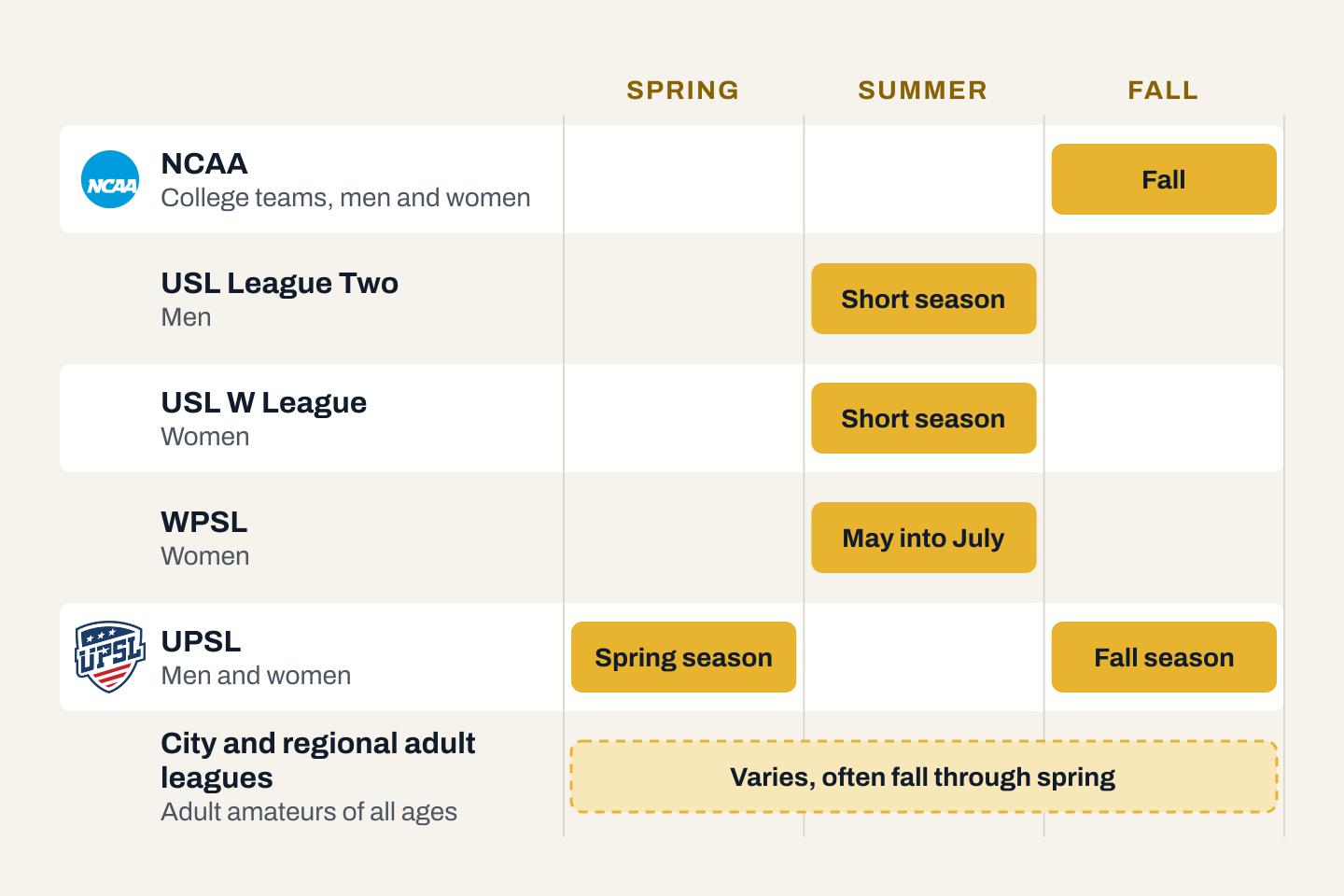
| League | Who plays | When it plays |
|---|---|---|
| NCAA | College teams, men and women, in Divisions I, II and III | Fall |
| USL League Two | Men, many of them college players | A short summer season |
| USL W League | Women, many of them college players | A short summer season |
| WPSL | Women | Summer, from May into July |
| UPSL | Men and women, in several divisions | A spring season and a fall season |
| City and regional adult leagues | Adult amateurs of all ages | Varies, often fall through spring |
On MyLeagueRankings these sit at three levels you can filter by on the leagues page: College, Semi-Pro and Amateur.
College soccer
The NCAA is the main body for college soccer and is split into three divisions. Division I has the largest programs. Divisions II and III are smaller, with their own national championships. Schools outside the NCAA play in other associations with their own national championships, including the NAIA and, for two-year colleges, the NJCAA.
Inside each division, schools are grouped into conferences. A team plays a conference schedule plus non-conference games in the fall. Most conferences then hold a tournament, and a national tournament follows.
Two things make college tables read differently from a youth league table:
- Conference and overall records are separate. A team has a record against its conference and a record against everyone.
- Schedules vary a lot. Non-conference opponents are chosen by each school, so two teams in one conference can face very different schedules.
In our catalog each conference is a flight with its own standings and power ranking.
Summer leagues for college players
College seasons are short, so many college players join a summer team.
USL League Two is the men's league and the USL W League is the women's equivalent, both run by the United Soccer League, which calls them pre-professional leagues for top college and aspiring professional players. They play a compact summer season followed by playoffs, in the weeks when college players are free. Teams are organized into divisions by region.
The WPSL (Women's Premier Soccer League) is a national women's league organized into regional conferences, and it also plays in the summer.
College players fill many of these rosters. Eligibility rules are detailed and change, so a player should confirm with the college's compliance office before joining any team.
The UPSL
The UPSL (United Premier Soccer League) is a national league for adult teams with a different shape from the summer leagues.
- It plays two seasons a year, spring and fall, each with its own tables.
- It has several divisions: a Premier division, Division 1 and Division 2, along with a women's division and an academy division.
- It presents Division 2, Division 1 and Premier as a ladder with promotion and relegation, which is unusual in American soccer. See where promotion and relegation exists.
Teams are grouped into regional conferences inside each division.
City and regional adult leagues
Under the national amateur leagues is the broadest part of the adult game: leagues run for one city or region. Large ones stack many divisions, from a Premier division down through numbered divisions, and add over-30, over-40 and over-50 divisions and coed play.
Texas has several large examples, including the Austin Men's Soccer Association, the Austin Community Soccer Association and the Houston Football Association. See how soccer is organized in Texas.
How the level connects upward
No team is promoted from this level into the professional leagues. What connects the levels is players. Professional clubs scout college soccer and the summer leagues.
Teams have one direct route to professional opponents: the U.S. Open Cup, the national knockout cup. Amateur clubs enter it through qualifying rounds, and the champions of competitions such as USL League Two and the UPSL receive places, so amateur sides meet professional clubs there.
What a youth player should take from this
- College is one path, not the only one. Plenty of players keep playing at a high level in adult leagues without a college team.
- The college season is short. It is played in the fall, which is why many college players add a summer league.
- Levels overlap. A strong UPSL or city league Premier division can include former college players.
- Nothing here is guaranteed. No youth league, ranking or showcase guarantees a college place. Coaches recruit players, not league names.
Rankings at this level
We rank these leagues the same way we rank youth leagues: from final scores, one flight at a time, with strength of schedule built in. That matters more here than anywhere, because schedules at this level are so uneven. Read how rankings are calculated.
To look up a team or a league, use the explore page.