
ECNL, MLS NEXT and Girls Academy: The National Youth Leagues Explained
What MLS NEXT, the ECNL and the Girls Academy are, who plays in them, the regional leagues underneath each one, and why a team cannot simply win its way in.
By MyLeagueRankings ·
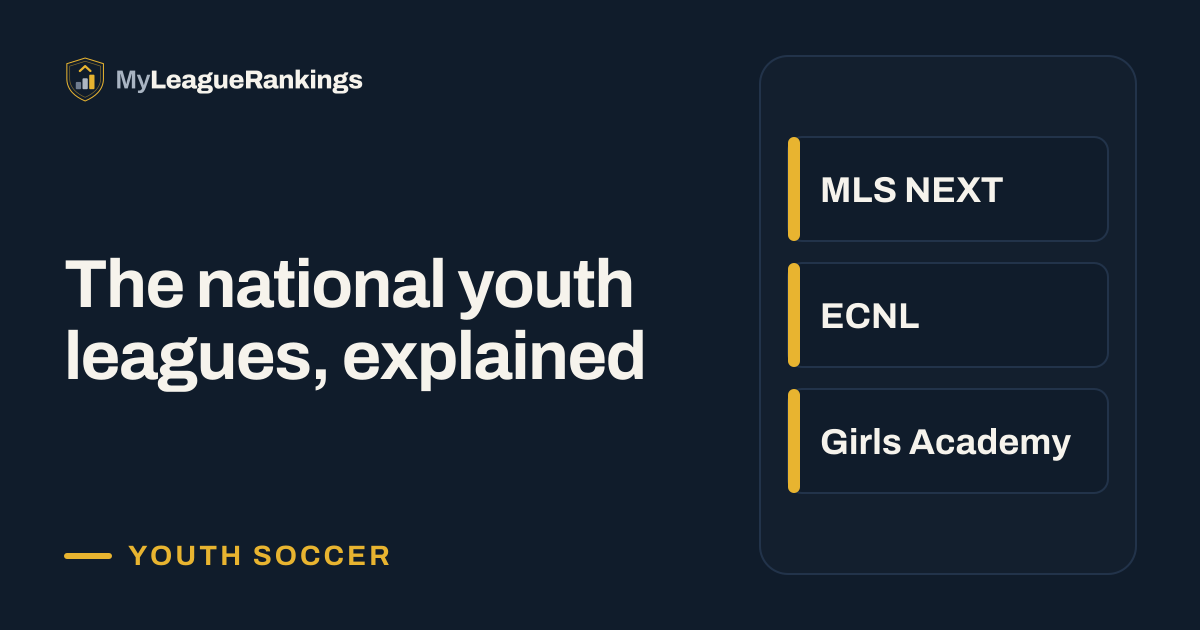
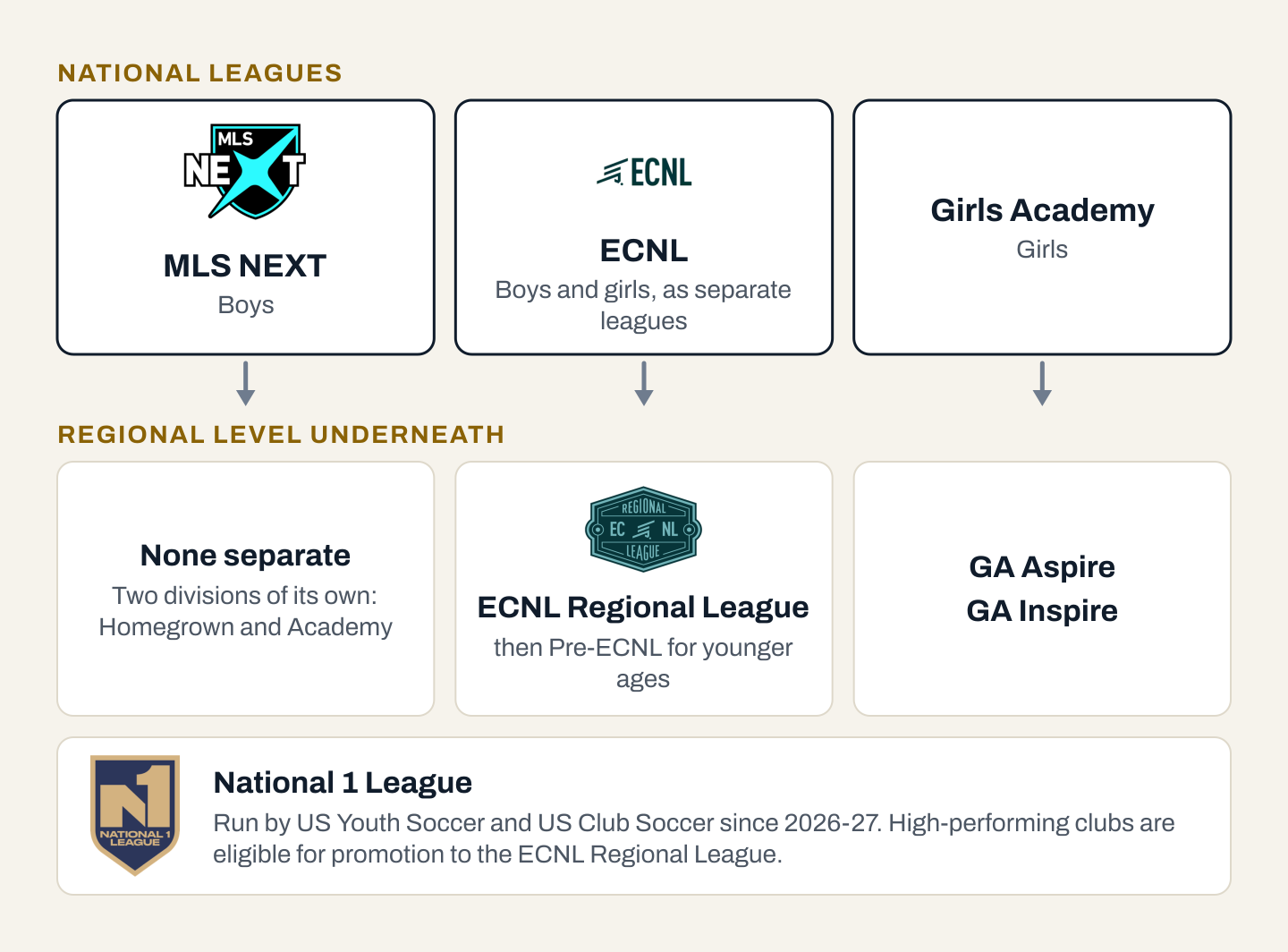
MLS NEXT, the ECNL and the Girls Academy are the national youth leagues in the United States. MLS NEXT is for boys, the Girls Academy is for girls, and the ECNL runs both a boys and a girls league. All three are organized by club membership: a club is admitted, and its teams from about U13 to U19 play a conference schedule with national events and playoffs.
Each one also has regional leagues underneath it. Knowing which name sits at which level clears up most of the confusion.
The three leagues side by side
| League | Who plays | Regional level underneath |
|---|---|---|
| MLS NEXT | Boys | None separate. MLS NEXT has two divisions of its own, Homegrown and Academy |
| ECNL | Boys and girls, as separate leagues | ECNL Regional League, then Pre-ECNL for younger ages |
| Girls Academy | Girls | GA Aspire and GA Inspire |
A fourth name belongs in the same conversation. The National 1 League started in the 2026-27 season and combines US Youth Soccer's National League with US Club Soccer's NPL. The two organizations describe it as their top team-based competition, and it is organized into conferences and districts.
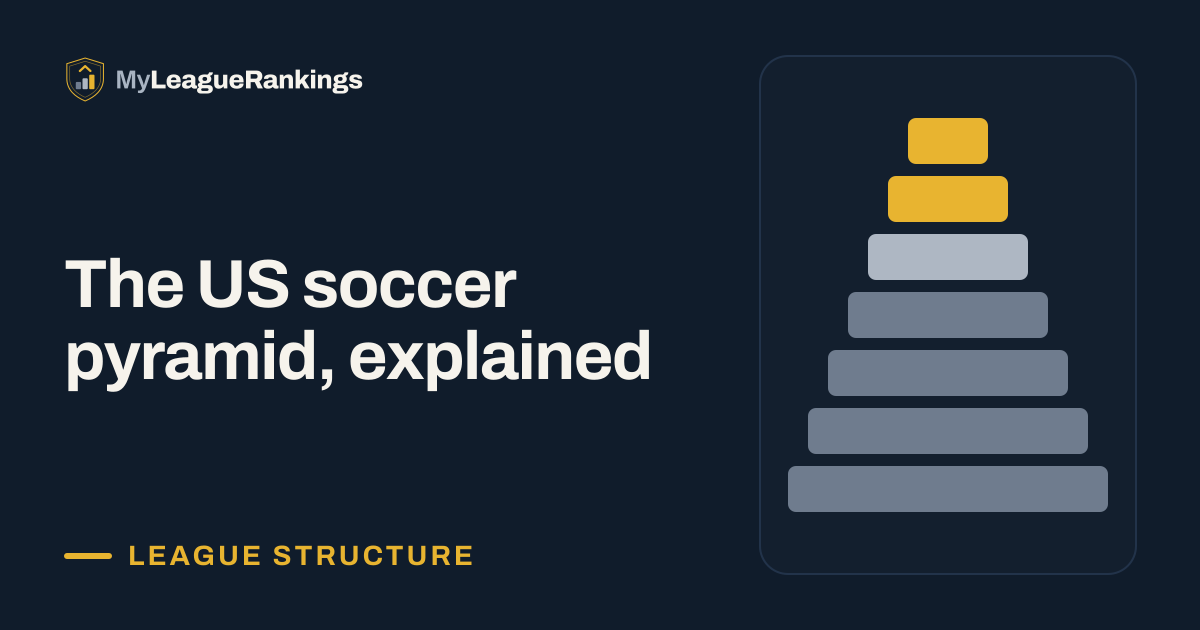
On our pyramid page, the three national leagues form one level and the regional leagues form the level below.
MLS NEXT
MLS NEXT is the boys league run by Major League Soccer. Its members are the academies of MLS clubs together with independent youth clubs that have been admitted. It should not be confused with MLS NEXT Pro, which is a professional league where MLS clubs field their reserve teams.
MLS NEXT has two divisions, the Homegrown Division and the Academy Division. The season ends with MLS NEXT Cup, the league's national postseason, which teams from both divisions qualify for.
The two divisions also draw their age groups differently from 2026-27: Homegrown keeps calendar birth years, and Academy uses the August 1 school-year window. See age groups explained.
ECNL
The ECNL (Elite Clubs National League) runs a girls league and a boys league. Each is divided into geographic conferences, and teams play most of their regular season inside their conference. National events and a postseason sit on top of the conference schedule, and conferences can run a league cup alongside the regular season.
Two leagues sit below it:
- ECNL Regional League, often written ECNL RL. It has its own set of conferences. Many ECNL clubs enter their second teams here, next to the first teams of clubs that are not ECNL members.
- Pre-ECNL, for the younger ages before the ECNL age groups begin.
Girls Academy
The Girls Academy, usually shortened to GA, is a national girls league organized into conferences, with national events and playoffs. Below it is GA Aspire, which the Girls Academy introduced in 2025 as its tier-two league: clubs apply to join, and it is meant as the bridge into the top tier. GA Inspire is a further league under the Girls Academy name, and we place it at the same regional level.
National 1 League
The National 1 League divides the country into eight conferences (Central, Mid-Atlantic, Midwest, Northeast, Northwest, South, Southeast and West) and each conference into numbered districts, 34 in all. A district is operated by an existing league or state association, whose name often appears next to the district name.
It is tied to the ECNL. The first season ends in summer 2027 at the ECNL's Conference League playoffs and finals, where district qualifiers from the National 1 League compete for championships, and high-performing clubs are eligible for promotion to the ECNL Regional League.
How a team gets in
This is the part that surprises parents coming from state leagues. In a state league, a team that wins its division moves up. In the national leagues that is not how it works.
- Clubs are admitted, not teams. A league accepts a club, and that club then enters teams across the age groups.
- Results still matter, indirectly. The ECNL, for example, moves clubs up from its Regional League between seasons, and a club that keeps winning there is the kind that is chosen.
- Players move more easily than teams. A strong player at a club outside these leagues gets in by making the roster of a member club at tryouts.
The mechanics are compared across all levels in promotion and relegation in American soccer.
Is one league better than another?
Not in a way a single sentence can settle, and we do not rank the leagues against each other. A few things are true of all three:
- The quality gap inside a league is often wider than the gap between leagues. The top and bottom of one conference can be far apart.
- Conferences are not equal. Some are deeper than others at a given age.
- The best league for a player is frequently the one where the player will actually play.
What can be measured is how a team is doing against the teams it plays. That is what a ranking is for.
How these leagues appear in our rankings
On the leagues page, a conference is listed as its own league: ECNL Girls Texas, for example, is one entry. Inside it, each group of teams of one age and sex that shares a table is a flight with its own standings and power ranking.
Ratings are compared inside a flight, because teams in different conferences rarely play each other during the regular season. We do not publish one national list across conferences. The method is explained in how rankings are calculated.
Where to go next
- For the full picture from rec to pro, read the US soccer pyramid explained.
- For one state's version of these levels, see how youth soccer is organized in Texas.
- For age group rules, see youth soccer age groups explained.
- To find a club's teams across leagues, use the explore page.