
Promotion and Relegation in American Soccer: Where It Exists and Where It Doesn't
The top American leagues are closed, but promotion and relegation is common in state youth leagues and adult amateur soccer. Here is where results move teams and where they do not.
By MyLeagueRankings ·
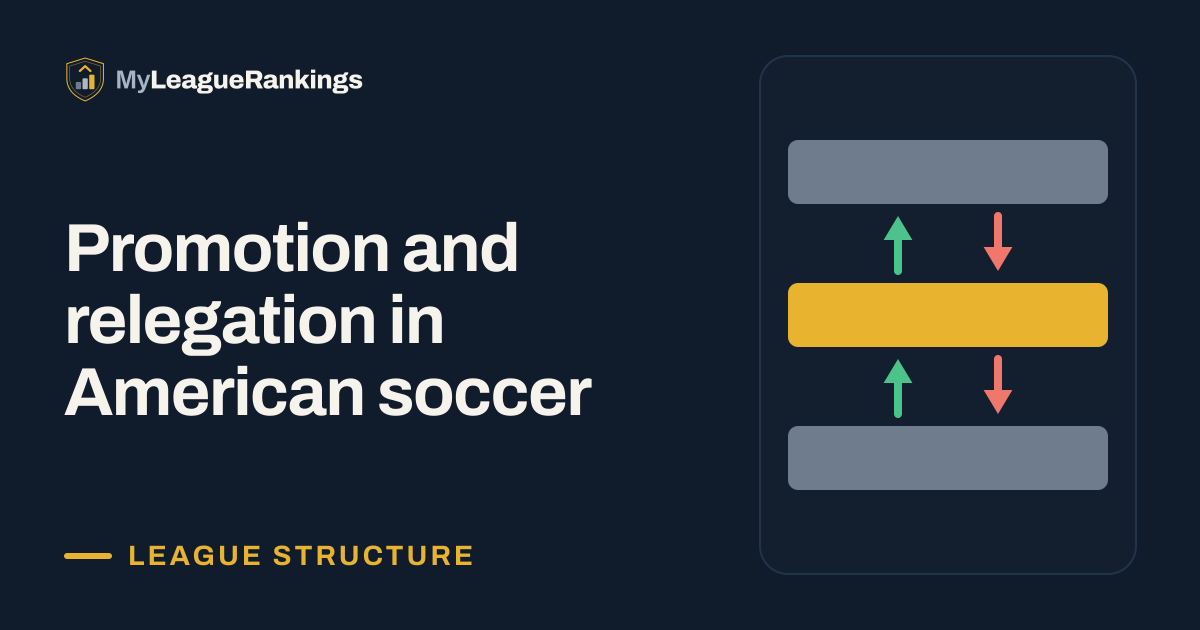
Promotion and relegation means the best teams in a division move up at the end of a season and the worst move down. In American soccer it does not exist at the top: Major League Soccer and the NWSL are closed leagues. It does exist lower down, in many state and local youth leagues and in adult amateur leagues, and the USL plans to bring it to its professional men's leagues in 2028.
Between those two ends sits a third system that is neither: leagues where clubs are admitted by invitation.
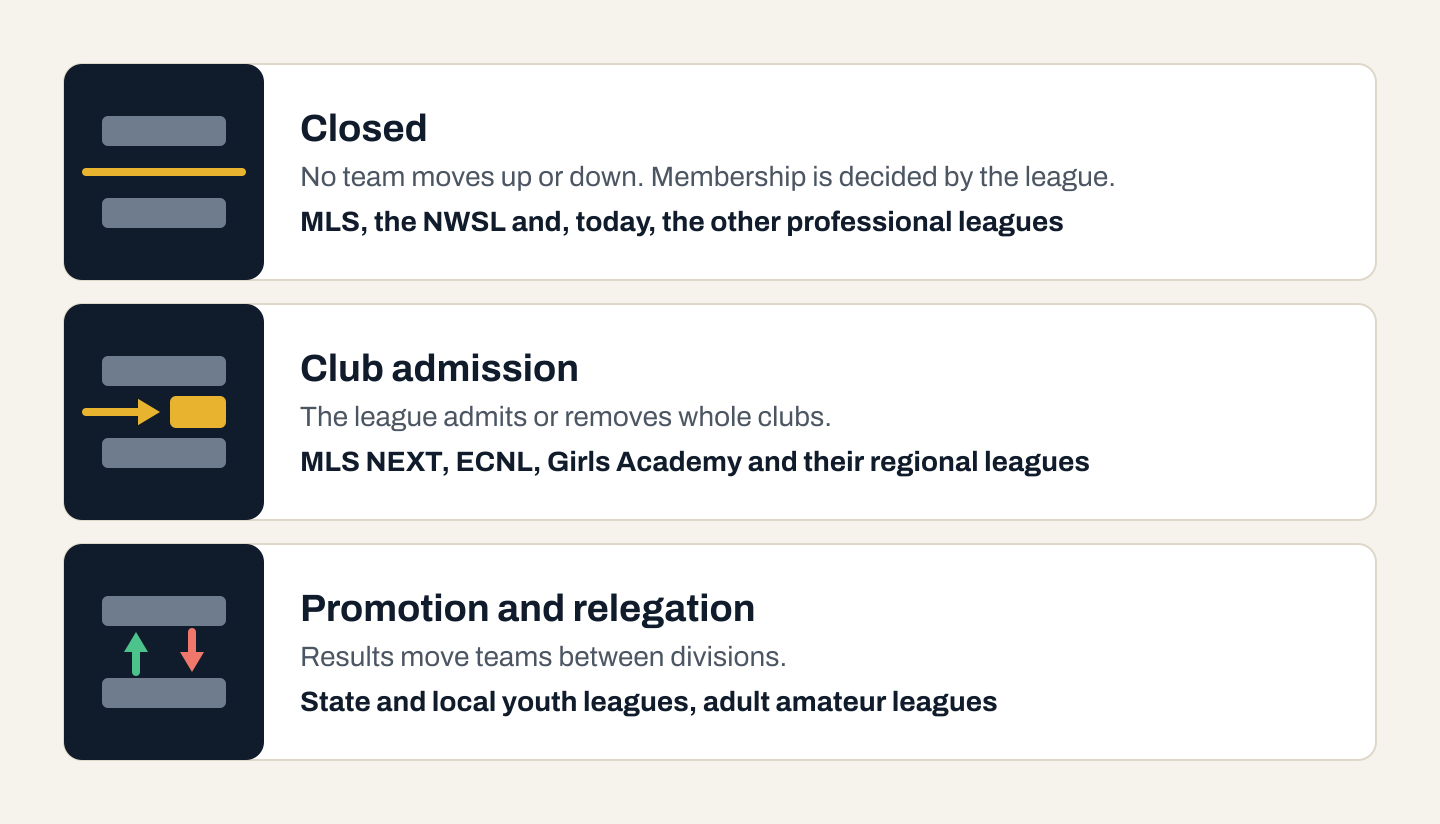
Three ways leagues decide who plays where
| System | How a team changes level | Where you find it |
|---|---|---|
| Closed | It does not. Membership is decided by the league | MLS, the NWSL and, today, the other professional leagues |
| Club admission | The league admits or removes whole clubs | MLS NEXT, ECNL, Girls Academy and their regional leagues |
| Promotion and relegation | Results move teams between divisions | State and local youth leagues, adult amateur leagues |
The professional game: closed
MLS is the men's first division, and the NWSL and the USL Super League are the women's first-division leagues. No team is promoted into any of them. The same is true one step down on the men's side: the USL Championship, USL League One and MLS NEXT Pro are professional leagues with no promotion into MLS. A club reaches these leagues by being accepted as a member, not by winning a lower division.
That is due to change inside the USL. Its club owners voted in 2025 to adopt promotion and relegation, and the league has announced a new top division, USL Premier, to launch in 2028 above the USL Championship and USL League One, with clubs moving between the three on results. It does not connect to MLS.
National youth leagues: admission
MLS NEXT, the ECNL and the Girls Academy are organized by club membership. A club is admitted, and then its teams across the age groups play in the league. A single strong team cannot win its way in on the field.
The regional leagues under them work as the proving ground. A national-league club often places its second team there, and a club that keeps winning there is the kind that gets moved up. Movement happens, but by decision of the league and for the whole club.
The National 1 League is the newer piece. It is team-based, and its high-performing clubs are eligible for promotion to the ECNL Regional League.
More on these leagues is in the national youth leagues explained.
State and local youth leagues: results decide
This is where promotion and relegation is part of everyday life. A state or local league sorts each age group into divisions by strength, with names such as Premier, Division 1, Gold and Silver. In the leagues that use promotion and relegation, the top teams move up a division at the end of the season and the bottom teams move down.
How it works in practice varies by league:
- Automatic places. The top one or two teams go up and the bottom one or two go down.
- Playoffs. Some leagues hold a championship group for the top teams and a relegation playoff for the bottom ones.
- Seasonal resets. Some leagues with separate fall and spring seasons move teams between the two.
- Applications. Some leagues let a club request a higher or lower placement, for example when a roster has changed a lot.
For a team in one of these leagues, the standings matter all the way down the table. Finishing eighth instead of ninth can decide which division you play in next season.
Adult amateur soccer: results decide here too
Promotion and relegation is also common in the adult game below the professional level.
- National amateur leagues. The UPSL is organized into a Premier division with Division 1 and Division 2 below it, and presents the three as a ladder that clubs climb by promotion.
- City leagues. Large local leagues stack many divisions, with a Premier division on top and numbered divisions beneath it. The Austin Men's Soccer Association is an example: after the fall and spring games, two teams win promotion to a higher division and two are relegated.
These leagues are covered in where college and amateur leagues fit.
Why the top is closed
The closed structure of the American professional leagues follows the model of other major American sports. Clubs buy into the league, and their place does not depend on last season's table. Supporters of that model point to stable investment in stadiums and academies. Critics point to the missing incentive at the bottom of the table and the missing pathway for ambitious lower-division clubs.
Whatever your view, it explains the shape of the US soccer pyramid: the levels are stacked, but they are not all connected by results.
What this means for your team
- In a state or local league, check the promotion and relegation rules at the start of the season, not the end. Know how many teams move and whether there is a playoff.
- In a national or regional league, your team's place next season depends on the club's membership, not on where the team finishes.
- For a player, the fastest route up is usually a tryout at a club in a higher league, not waiting for a team to be promoted.
Where rankings help
When a division line is decided by a point or two, the official standings are what count. The power ranking adds context the table cannot: how strong each team's schedule was and how convincingly it won. That is useful when you want to know whether a newly promoted team is likely to hold its own, or whether a team near the bottom has been unlucky with its schedule.
See how to read a league table and how rankings are calculated, or browse divisions on the leagues page.