
Youth Soccer Age Groups Explained: Birth Year, School Year and What U14 Means
What the U in U14 means, how the August 1 cutoff used from the 2026-27 season differs from birth-year age groups, and how to read the years in a team's name.
By MyLeagueRankings ·
U14 means "under 14": the group is for players who had not turned 14 before the cutoff date for that season. Which players that includes depends on where the cutoff falls. From 2017 American youth soccer grouped players by calendar birth year. From the 2026-27 season, US Youth Soccer, US Club Soccer and AYSO group them by a twelve-month window that starts on August 1, which lines up with school grades.
That change is why a team's name and its age group can seem to disagree. Here is how to read both.
Two ways to draw the line
| System | A group is made of players born | Typical team label |
|---|---|---|
| Birth year | January 1 through December 31 of one year | One year: 2012, G2012, B12 |
| School year | August 1 of one year through July 31 of the next | Two years: 2012/13, G2012/13 |
Under the birth-year system, children in the same school grade were often split across two soccer age groups, because a grade includes fall birthdays from one calendar year and spring birthdays from the next. The August 1 cutoff keeps most classmates together.
Not every league made the same choice for 2026-27:
- US Youth Soccer, US Club Soccer and AYSO moved together to the August 1 through July 31 window. That covers most state and local leagues and the leagues those bodies sanction, the ECNL among them.
- The Girls Academy adopted the same August 1 window.
- MLS NEXT split by division. Its Homegrown Division keeps calendar birth years, and its Academy Division uses the August 1 window.
Check the rule your own league publishes for the season you are registering for.
Age groups for the 2026-27 season
For leagues using the August 1 cutoff, these are the birth windows for the 2026-27 season.
| Age group | Born from | Born through |
|---|---|---|
| U10 | August 1, 2016 | July 31, 2017 |
| U11 | August 1, 2015 | July 31, 2016 |
| U12 | August 1, 2014 | July 31, 2015 |
| U13 | August 1, 2013 | July 31, 2014 |
| U14 | August 1, 2012 | July 31, 2013 |
| U15 | August 1, 2011 | July 31, 2012 |
| U16 | August 1, 2010 | July 31, 2011 |
| U17 | August 1, 2009 | July 31, 2010 |
| U18 | August 1, 2008 | July 31, 2009 |
| U19 | August 1, 2007 | July 31, 2008 |
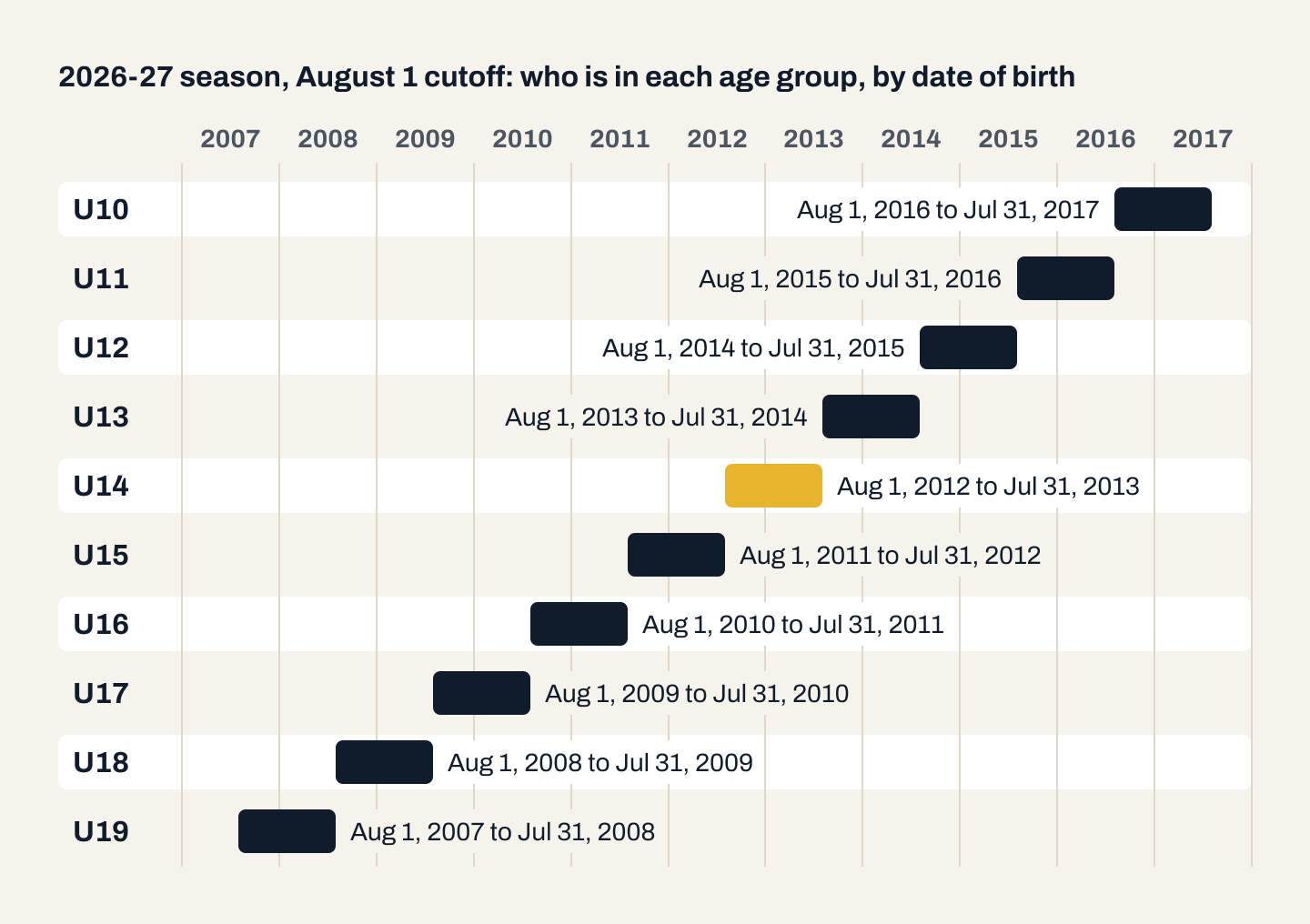
The pattern is easy to extend. Each team moves up one number every August, and the windows shift forward one year. Leagues often combine the oldest two groups and play them as U18/U19.
The quick math
For a season written with two years, such as 2026-27, take the second year.
- School-year system: subtract the later of the two birth years in the window. A player born between August 2012 and July 2013 is in U14 for 2026-27, because 2027 minus 2013 is 14.
- Birth-year system: subtract the birth year. A team of players born in 2011 was U15 in 2025-26, because 2026 minus 2011 is 15.
Reading the years in a team name
Clubs name teams by birth year far more often than by U-number, because a birth year stays the same as the team grows up.
- G2013 or B2013 means girls or boys born in 2013. You will also see short forms such as G13 or 13B.
- 2012/13 means the August 2012 through July 2013 window. Under the August 1 cutoff this is a common label.
- A level word such as Premier, Elite, Gold, or a color, tells apart two teams of the same age at one club.
Be careful with two-year labels. A label such as 2012/13 can mean one August-to-July window, and a combined age group such as U18/U19 also carries two years. When a name is ambiguous, the age group the league lists the team under is the one that counts.
Combined age groups
Older age groups are often merged, because rosters thin out as players reach the end of high school. U15/U16 and U18/U19 are the common pairs. A combined group plays as one, with one table.
On MyLeagueRankings, every flight is filed under a standard age label such as U14 or U15/U16, whatever wording the league uses on its own schedule. That is what lets you filter leagues and teams by age across different leagues.
Playing up
Most leagues let a player or a whole team play in an older age group. Playing in a younger one is a different matter: US Youth Soccer, for one, grants no age exceptions in its own national competitions.
- A player plays up when the club places them on an older team.
- A team plays up when the club enters it in an older division, usually to find stronger opponents.
When a team plays up, its results count in the age group it actually plays in. A U13 team entered in a U14 flight is ranked against the U14 teams in that flight.
Field size by age
Age also decides the size of the game. U.S. Soccer sets the largest format allowed at each age, and a league may play smaller:
| Age | Largest format |
|---|---|
| U8 and younger | 4v4 |
| U9 and U10 | 7v7 |
| U11 and U12 | 9v9 |
| U13 and older | 11v11 |
The move to 11v11 at U13 is also about where the national youth leagues begin.
What to remember
- The U-number is a ceiling. Nobody in U14 turned 14 before the season's cutoff date.
- From 2026-27 the common cutoff is August 1, and team names often show two years. MLS NEXT's Homegrown Division is the main exception.
- The age group a league lists a team under decides who it plays, and that is the group it is ranked in.
For the other words on a schedule, see the glossary of league terms. For what happens at each age and level, see the US soccer pyramid explained.