
State Cup, Presidents Cup and National Championships: How Cup Pathways Work
Cups run beside the league season and follow different rules. Here is how State Cup, Presidents Cup, league playoffs, tournaments and showcases differ, and what advancing means.
By MyLeagueRankings ·
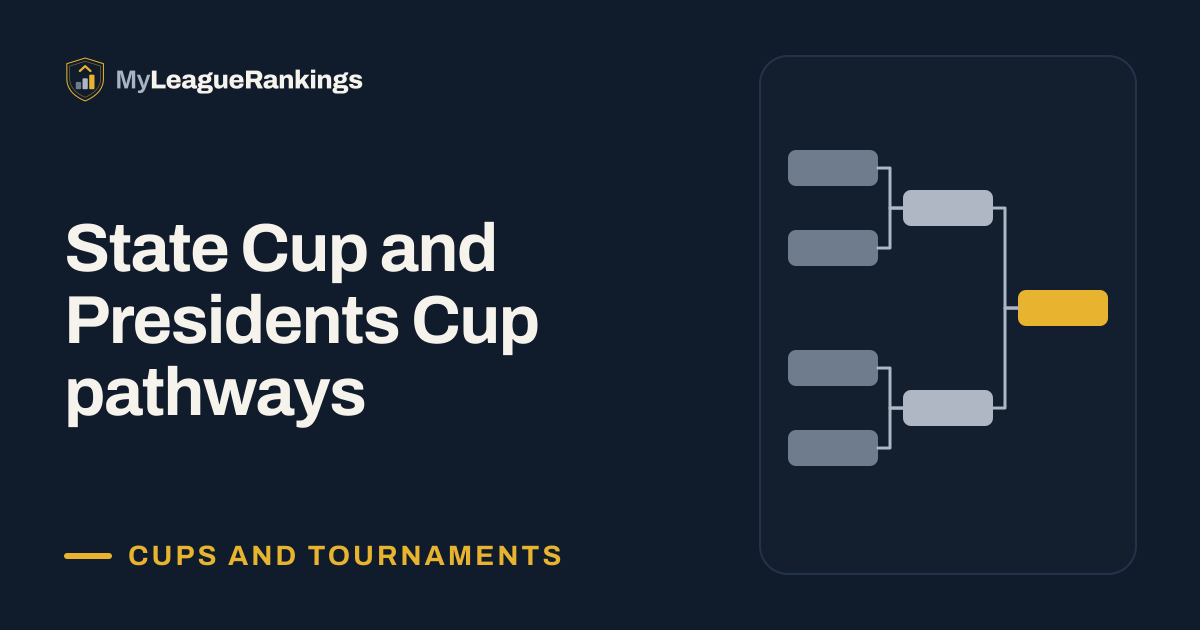
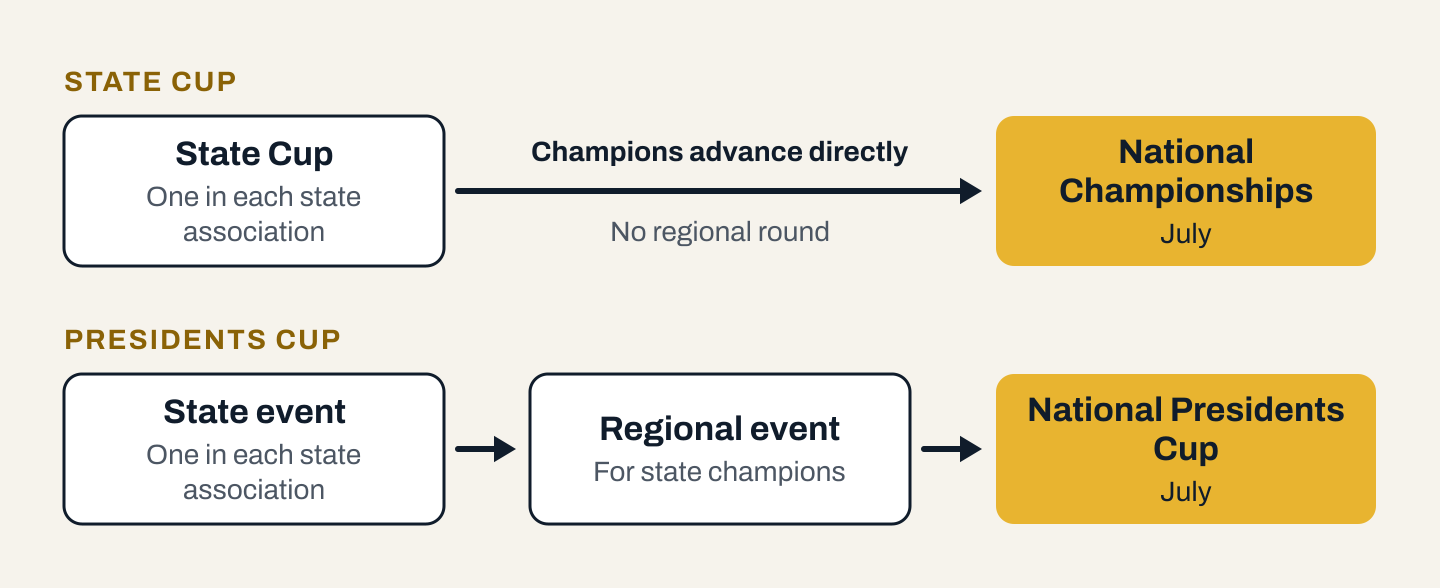
State Cup and Presidents Cup are the two cup pathways of US Youth Soccer, and each state association runs its own. A State Cup champion advances straight to the US Youth Soccer National Championships. A Presidents Cup champion advances to a regional event, and the regional winners meet at the National Presidents Cup.
They are not the only path to a national title, and they are not the same thing as a weekend tournament or a showcase. This guide separates them.
Four kinds of event
| Kind | What it is | What is at stake |
|---|---|---|
| Cup | Runs beside a league season and ends in a knockout stage | A title, and often a place in the next round up |
| League playoffs | The postseason of one league, for teams that qualified through its regular season | That league's championship |
| Tournament | A stand-alone event, usually one weekend | The tournament itself |
| Showcase | An exposure event scheduled for good matchups | Being seen by college coaches |
On MyLeagueRankings, cups, tournaments and showcases are listed on the competitions page, separate from leagues.
State Cup
State Cup is the top cup competition of a US Youth Soccer state association. Teams registered with that association enter by age group, play through group games and knockout rounds, and one team per age group wins the state.
A State Cup title is also the first step toward a national one. State champions used to go to a regional championship first. In September 2025 US Youth Soccer announced the end of that round: the State Cup champions of all 54 state associations now advance directly to the National Championships, held in July. Not every age group goes on. In North Texas, for example, it is the champions from 13U up.
There are more associations than states because some states are divided in two, and each half runs its own State Cup. Texas is one of them: North Texas and South Texas each crown their own champions. See how youth soccer is organized in Texas.
Presidents Cup
Presidents Cup is US Youth Soccer's second cup pathway, for competitive teams a level below the State Cup field. It still has three steps: a state event, a regional event, and the National Presidents Cup in July.
Each state association sets who enters which cup. South Texas, for example, seeds its State Cup from the standings of its Division I leagues and recommends Presidents Cup for the teams not seeded into it. Ask your club which cup your team is entered in and why.
US Youth Soccer has said both competitions continue alongside the National 1 League, the league it started with US Club Soccer in 2026-27, and that it is looking at changes for later seasons.
League playoffs and league cups
The national leagues run their own postseasons. MLS NEXT, the ECNL and the Girls Academy each end the season with a postseason for the teams that qualified, and it produces that league's national champions. MLS NEXT's is called MLS NEXT Cup. These are separate from State Cup. A team's league decides which postseason it is playing toward.
Leagues also run cups during the season. A league cup is played among the league's own teams alongside the regular schedule and has its own winner.
The result is that "national champion" has more than one meaning in American youth soccer. Each organization crowns its own. When you hear the phrase, ask which competition it refers to.
Tournaments and showcases
Tournaments are stand-alone events. A club or an organizer hosts one, teams apply, and over a weekend each team plays group games followed by a bracket for the teams that advance. Winning one is an achievement in its own right, but it does not change a team's league standing and usually does not lead anywhere else.
Showcases exist for exposure. Games are scheduled so that teams of similar strength meet in front of college coaches. Some showcases keep placement brackets, but the result matters less than the minutes played.
How a cup or tournament is decided
Most cups and tournaments have two stages.
- Group stage. Teams are placed in groups, and each team plays the others in its group. A table decides who advances, using the event's points system and tiebreakers.
- Knockout stage. The teams that advanced are paired in a bracket. Winners move on and losers are out, sometimes with placement games for third place and below.
Three details are worth checking in the event rules before the first game:
- The points system. Many youth events do not use the standard 3 points for a win. A common alternative awards extra points for goals and for a shutout.
- The tiebreakers. Head-to-head result, goal difference and goals allowed are used in different orders by different events, and goal difference per game is often capped.
- Shootouts. A knockout game level at full time usually goes to penalty kicks. Some events also use shootouts in the group stage and award points for them.
We explain these systems in how to read a league table.
How cups relate to rankings
Our power ranking is built for league play, where a flight of teams plays a schedule against each other over a season. That gives enough connected results to rate teams fairly. A cup or tournament gives each team only a handful of games against opponents it may never meet again.
So for cups and tournaments we show what the event itself decides: the group tables and the bracket. For league flights we show the standings and the power ranking, which is explained in how rankings are calculated.
Practical advice for parents
- Read the event rules. Points, tiebreakers and roster rules differ from your league's.
- Do not judge a season by one weekend. Three group games are a small sample. A league table over a season tells you more.
- Ask which pathway a team is on. State Cup, Presidents Cup and a league's own playoffs lead to different places.
- Check the dates each year. Formats and qualification rules change. Your state association and your league publish the current ones.
To see how the terms fit together, use the glossary of league terms.